Removing a wall or installing a steel beam? Find out when Building Regulations approval is required for structural work in the UK, and the risks of skipping it.
What Counts as Structural Work Under Building Regulations?
Structural work is any alteration that changes how loads are carried through the building. In practical terms, this includes:
- Removing or cutting into load-bearing walls, whether internal or external
- Installing steel beams, RSJs, or lintels to support openings
- Altering or removing chimney breasts, especially where the stack above remains
- Underpinning or altering foundations
- Cutting notches or holes in floor joists or roof timbers beyond permitted tolerances
- Adding or removing structural supports in loft conversions
- Inserting or widening door and window openings in load-bearing walls
The common factor is load transfer. If the work changes how weight moves through the structure, or removes something that currently carries weight, it requires approval. This applies regardless of the size of the alteration. Removing a one-metre section of wall can be just as significant structurally as removing an entire wall if that section is load-bearing.
We've worked on Victorian and Edwardian terraces across Wirral for over a decade. In these properties, almost every internal wall plays some role in the structure — even if it appears to be a simple partition. Assuming a wall is non-load-bearing without a structural survey is a risk.

When Do You Need Building Regulations Approval for Structural Work?
You need approval before the work starts. The process requires either a Full Plans application or a Building Notice, both submitted to Building Control before any structural changes are made.
Full Plans Application
A Full Plans application involves submitting detailed drawings and structural calculations in advance. Building Control reviews the plans, requests amendments if needed, and issues formal approval before work begins. This route provides certainty — you know the design is compliant before spending money on materials or labour.
The application fee in Wirral typically falls between £300 and £800 depending on scope, with structural engineer fees adding another £400 to £1,200 for calculations.
Building Notice
A Building Notice is a simpler process. You notify Building Control that work is starting without submitting full drawings upfront. Inspections happen as the work progresses, and compliance is assessed on site. This can be faster to initiate, but carries more risk — if Building Control identifies a non-compliance during inspection, you may need to alter or redo completed work.
For structural projects, we recommend Full Plans. The upfront effort avoids costly corrections later.

Building Regulations Approval vs Planning Permission: What's the Difference?
Many homeowners assume these are the same thing. They are not — and confusing them is one of the most common mistakes we see on Wirral projects.
| Criteria | Building Regulations Approval | Planning Permission |
|---|---|---|
| What it controls | Structural safety, fire safety, insulation, drainage, ventilation, accessibility | External appearance, visual impact, land use, impact on neighbours and the streetscape |
| When you need it | Structural alterations, extensions, loft conversions, electrical work, some window replacements | Extensions, new buildings, significant external changes, changes of use |
| Who approves it | Building Control Officer (local authority or approved inspector) | Local Planning Authority (council planning department) |
| Needed for structural work? | Yes, almost always | Only if the work also changes the external appearance or footprint of the building |
You can have planning permission for an extension but still need separate Building Regulations approval for the structure, drainage, insulation, and fire safety. Equally, internal structural work can need Building Regulations approval without needing planning permission at all because nothing externally changes.
In Merseyside, homeowners sometimes submit a planning application for an extension, receive approval, and assume they can proceed. They cannot — not legally. The structural work still requires a separate Building Regulations application and inspection process.
How Many Inspections Does Building Control Carry Out?
Structural projects typically require at least three key inspections:
- Foundation or base inspection — if any groundwork or underpinning is involved, Building Control inspects the foundation before concrete is poured
- Structural frame inspection — once steelwork or timber supports are installed but before walls are closed up, Building Control inspects the supports and checks they match the approved calculations
- Final inspection — once all work is complete, a final check confirms the structure is safe, compliant, and matches the approved plans
Each inspection must be requested by the contractor or homeowner at the correct stage. Missing an inspection — or closing up work before it is inspected — can result in enforcement action. Building Control has the authority to require walls to be reopened if work was covered prematurely.
Building Control typically requires 24 to 48 hours notice for each inspection. Delays in requesting inspections extend the project timeline. We manage this schedule on every structural project — you should not need to chase it yourself.
A Mistake CNR Sees Regularly on Wirral Projects
Homeowners carrying out structural alterations — particularly removing chimney breasts, which is common in the older Victorian and Edwardian terraces that make up a large proportion of Wirral's housing stock — frequently remove the breast on one floor without supporting the remaining stack above, then proceed without Building Regulations approval because they assume it is a minor job.
This is both a structural failure risk and a legal liability that surfaces at the point of sale. The chimney stack above the removed breast is now unsupported — it relies on the breast below to carry its weight down to the foundations. Remove the breast without proper support, and that load path is severed. The stack can crack, move, or in extreme cases collapse.
Even if the removal appears successful for months or years, the problem emerges when a solicitor requests Building Regulations completion certificates. If no certificate exists, the sale can stall. The buyer's mortgage lender may refuse to lend. The seller is then forced to apply for retrospective approval — more expensive, more uncertain, and sometimes impossible if the work does not meet current standards.
The work itself is not complex when done correctly — a steel support or gallows bracket carries the load of the remaining stack — but it must be calculated by a structural engineer and inspected by Building Control. Skipping that process to save a few hundred pounds creates a liability worth thousands.

What Happens if You Do Structural Work Without Building Regulations Approval?
Local authorities can issue enforcement notices requiring you to open up completed work for inspection, or in serious cases to remove and rebuild non-compliant structures. Enforcement action can be taken within 12 months of completion, or longer if the breach is ongoing.
When you sell the property, your solicitor will ask for Building Regulations completion certificates for any structural work carried out during your ownership. If you cannot provide them, your three options are:
Retrospective Regularisation
Costs more than the original application and requires the work to be inspected or partially opened up. Not guaranteed — if the work doesn't meet current standards, it may need rebuilding.
Indemnity Insurance
Shifts the risk to an insurer but does not confirm the work is safe. Many mortgage lenders will not accept it, particularly on newer buildings or recent work. Typically costs £100–£300.
Price Reduction
Negotiated by the buyer to reflect the risk. Often larger than the original cost of compliance — easily several thousand pounds.
None of these options are better than applying for approval before the work starts.
What Information Does a Structural Engineer Provide?
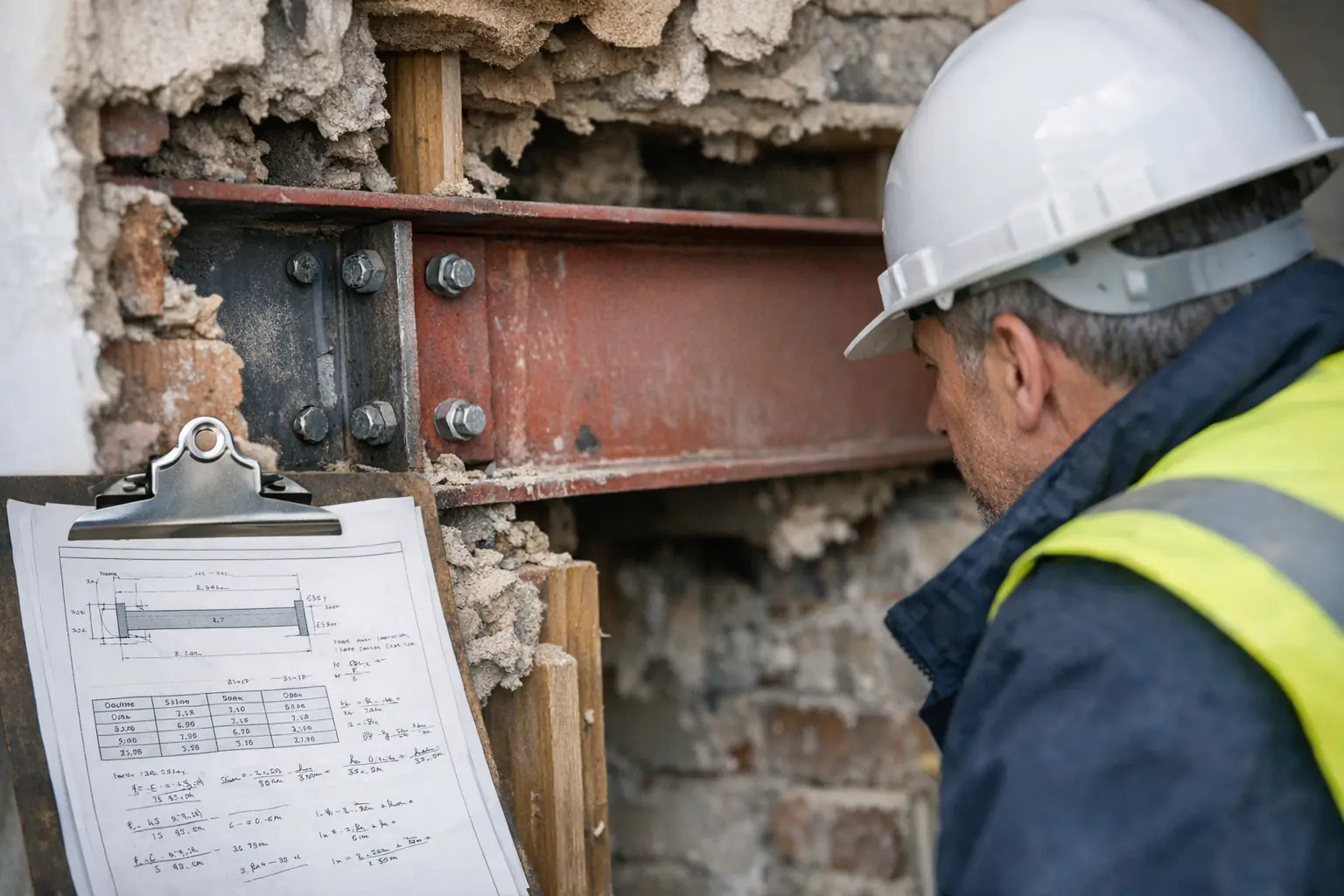
A structural engineer produces calculations that prove the proposed work is safe and compliant. For structural alterations in Wirral, this typically means load calculations showing how much weight the structure must support, beam size specifications (including the exact steel section required), foundation requirements if the new load exceeds existing capacity, and connection details showing how new steelwork is fixed to existing walls or supports.
These calculations are submitted as part of the Building Regulations application. Once approved, they become the legal specification for the work. The contractor must install exactly what the engineer specified — substituting a smaller beam or altering the design without approval invalidates the approval entirely.
Structural engineer fees — Merseyside
£400–£1,200
For a standard residential project such as a single wall removal or beam installation. More complex projects (loft conversions, multi-wall alterations) typically run £1,500–£3,000. These fees are separate from the Building Regulations application fee and construction cost.

Questions to Ask Any Contractor Before Structural Work Begins
Before you sign a contract or pay a deposit, confirm the contractor understands the legal requirements and will manage the process properly.
Will this project require Building Regulations approval — and who will submit the application?
The contractor should know the answer immediately. If they are uncertain, that is a red flag.
Are you using a Full Plans Application or a Building Notice, and what are the implications?
A competent contractor will explain the difference and recommend the appropriate route based on your project.
Will a structural engineer's calculations be required, and is that included in your quote?
Engineer fees are often excluded from initial quotes. Confirm whether they are included or need to be paid separately.
How many Building Control inspections will there be, and will you manage those?
The contractor should request inspections at the correct stages. You should not need to manage this yourself.
Will I receive a Completion Certificate at the end, and how long does that typically take?
Completion certificates are usually issued within 6–8 weeks of the final inspection. Confirm the contractor will ensure this is completed before they leave the project.
A contractor who cannot answer these questions clearly either lacks experience with Building Regulations or is planning to avoid the process entirely. Both scenarios put you at risk.
Can You Start Structural Work Before Approval Is Granted?
No. Starting work before Building Regulations approval is a breach of the Building Act 1984.
If you submit a Full Plans application, you must wait for formal approval before starting. Approval typically takes 5 to 8 weeks, though this varies by local authority. If you submit a Building Notice, you can start work immediately after submission, but Building Control has not reviewed the design in advance — creating the risk that inspections identify issues requiring changes to work already completed.
Starting work early is rarely worth the risk. If Building Control discovers the breach, they can issue a stop notice, require the work to be altered, or pursue enforcement action. Even if no enforcement occurs, the lack of proper approval creates the same problems at the point of sale as carrying out the work with no application at all.
How CNR Construction Handles Building Regulations on Structural Projects
CNR Construction submits the Building Regulations application as part of every structural project. This is not an optional extra — it is a legal requirement, and we include the process in our project timeline and cost estimate from the start.
For most projects in Wirral and Merseyside, we recommend the Full Plans route. We work with local structural engineers who produce the calculations, then submit the application to Building Control on your behalf. Once approval is granted, we schedule the work and request inspections at the correct stages. You receive copies of all approvals and inspection records as the project progresses.
At the end of the project, we ensure Building Control carries out the final inspection and issues the Completion Certificate — your proof of compliance, and a document that will be required when you sell the property.
If you are planning structural work in Wirral or Merseyside and need clarity on what approvals are required, view our structural work services or contact us directly for a fixed-price quote that includes all approvals, engineer fees, and inspections.
Ready for Your Free Quote?
No obligation, no pressure — just honest advice from Wirral's trusted builders.
Get a Free Quote